Features
JuhRadial MX turns the Logitech MX Master 4 (and the MX Master 3S / 3) into a fully programmable Linux power tool: a radial gesture menu, button and action remapping, thumb-wheel actions, SmartShift scroll, actuator haptics, Easy-Switch host control, per-application profiles, cross-computer JuhFlow, and a gaming mode with macros.
This page is the feature reference. For installation see Installation, for the on-disk config schema see Configuration, for compositor specifics see Compositor-Support, and for fixes see Troubleshooting.
Note
Most features depend on HID++ and so require a Logitech MX Master. In generic mouse mode (any mouse via evdev) the radial menu and button remapping still work, but Haptics, Easy-Switch, Flow, SmartShift, and the thumb-wheel card are hidden because they need Logitech-specific protocols.
Feature overview
| Feature | What it gives you | Needs HID++ |
|---|---|---|
| Radial Menu | 8-slice gesture ring with hold-drag or tap selection | No |
| Button & Action Remapping | Reassign back / forward / middle / shift-wheel and the gesture buttons | Partial |
| Thumb-Wheel | Bind the side wheel to volume, zoom, or horizontal scroll | Yes |
| Scroll & SmartShift | Pointer speed, wheel mode, SmartShift threshold, HiRes scroll | Yes |
| Haptic Feedback | Per-event actuator pulses with presets | Yes |
| Easy-Switch | Switch between paired computers, read paired names | Yes |
| Per-Application Profiles | Auto DPI / buttons / scroll on window focus | Yes |
| JuhFlow | Encrypted cross-computer cursor and clipboard (Linux and Mac) | No |
| Gaming Mode + Macros | DPI profiles, overlay suppression, macro engine | Partial |
Radial Menu
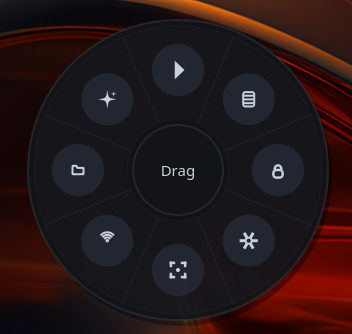
A circular overlay of eight action slices that appears at the cursor. It is drawn by the PyQt6 overlay process and positioned over the pointer wherever you are working.
Triggering it
The ring opens on whichever mouse button is bound to the Radial Menu action. By default that is the dedicated Actions Ring button on the MX Master 4 (the lower thumb control, shown in Settings as Show Actions Ring). The larger gesture button defaults to Virtual Desktops, and the two can be swapped or reassigned on the Buttons page.
Hold-drag vs tap
There are two interaction styles, and both work from the same press:
- Hold mode: press and hold the button, drag toward a slice, then release to execute that slice.
- Tap mode: give the button a quick tap. The menu stays open so you can move the pointer and click a slice to execute it.
The 8 slices
Slices are laid out clockwise from the top. The factory defaults are:
| Position | Default action |
|---|---|
| Top | Play / Pause |
| Top-Right | New Note |
| Right | Lock Screen |
| Bottom-Right | Settings |
| Bottom | Screenshot |
| Bottom-Left | Emoji Picker |
| Left | Files |
| Top-Left | AI (submenu) |
Open Settings → Buttons → Actions Ring and click any slice to customize it. Each slice can run one of several action kinds:
- Launch command (for example
flameshot gui,dolphin) - Keyboard shortcut (for example Copy
ctrl+c, Pastectrl+v) - Open Settings
- Submenu (the AI submenu opens Claude, ChatGPT, Gemini, and Perplexity)
- Emoji picker
- Do nothing
Launch commands adapt to your desktop: Screenshot, Files, Note editor, Emoji, and Lock resolve to the right tool for KDE, GNOME, COSMIC, or a generic fallback, so the same slice does the sensible thing on each environment.
Tip
Turn on Easy-Switch Shortcuts on the Buttons page to replace the Emoji slice with an Easy-Switch 1 / 2 / 3 submenu, so you can change host straight from the ring.
Minimal mode
The Minimal Radial HUD toggle (in the settings header) renders the ring as
floating icons only, with no pizza-slice wedges or text labels. It is a
quieter, lower-footprint HUD for users who already know the layout. Backed by
the radial.minimal_mode config key.
Themes
Themes recolor the entire wheel. Vector themes are drawn live in their own palette; the 3D themes ship bespoke pre-rendered wheel art. The theme preview in Settings shows the actual ring each theme produces before you apply it.
| Theme | Style |
|---|---|
| PHOSPHOR | Signature dark, phosphor accent |
| JuhRadial MX | Premium dark with cyan accents |
| Catppuccin Mocha | Soothing dark pastel |
| Catppuccin Latte | Light pastel |
| Nord | Arctic north-bluish |
| Dracula | Dark, vibrant |
| GitHub Light | Clean light |
| Solarized Light | Precision light palette |
| Pearl Blossom / Neon Sci-Fi / Dark Ember / Golden Classic | 3D rendered wheels |
The menu also animates: a bloom on open, smooth slice-hover crossfades, a droplet pop-out for submenu items, and a selection flash on the picked slice.
Button & Action Remapping
Reassign the mouse's physical buttons to system actions, media keys, clipboard shortcuts, or the radial menu. Configured in Settings → Buttons → Button Assignments.
Remappable buttons and defaults
| Button | Default action |
|---|---|
| Gesture | Virtual Desktops |
| Show Actions Ring (thumb) | Radial Menu |
| Middle | Middle Click |
| Shift-Wheel | SmartShift |
| Forward | Forward |
| Back | Back |
| Horizontal Scroll (thumb wheel) | Scroll Left/Right |
Available actions
Pick from a full catalog: Middle Click, Back, Forward, Copy, Paste, Undo, Redo, Screenshot, SmartShift, Scroll Left/Right, Volume Up / Down, Play/Pause, Mute, Radial Menu, Virtual Desktops, Zoom In / Out, Custom Action, Do Nothing, plus the portable system actions:
| System action | What it does |
|---|---|
| Show Desktop | Minimize everything to reveal the desktop |
| Switch Desktop Left / Right | Move to the adjacent virtual desktop |
| Task Switcher | Open the window switcher / overview |
| Close Window | Close the active window |
| Lock Screen | Lock the session |
| Calculator | Launch the calculator |
Each system action uses the native mechanism for your desktop (GNOME, KDE, Hyprland, Sway, COSMIC), so it behaves correctly across environments.
Note
Reassigned actions are injected through the kernel uinput device, so they fire on Wayland as well as X11.
How diverting works (and why it is safe)
The gesture and Actions Ring buttons are always handled by the daemon. The back, forward, middle, and shift-wheel buttons are only intercepted (HID++ diverted) when you reassign them away from their native default. Return any of them to its default and the daemon clears the divert, so the hardware behavior comes back immediately, no reconnect required. See Architecture for the divert model in detail.
Thumb-Wheel
The small side thumb-wheel on the MX Master can drive a system action instead of its default behavior. Configured in Settings → Point & Scroll → Thumb Wheel (Logitech only).
| Control | Options |
|---|---|
| Action | Off · Volume · Horizontal scroll · Zoom |
| Invert Direction | Reverse which way rotation maps |
| Speed | 1 to 8 (repeats applied per rotation notch) |
- Volume and Zoom divert the wheel to HID++ notifications and re-inject the action. Zoom uses layout-independent keys, so it works on non-US keyboards.
- Horizontal scroll keeps the wheel's native hardware scrolling, which is reliable on every compositor.
- Off leaves the wheel at its native behavior.
Invert is applied in software, and Speed reaches the daemon through the config reload, so neither needs a special hardware command.
Scroll & SmartShift
Pointer and scroll tuning lives on the Point & Scroll page.
Pointer speed (DPI)
- DPI slider from 400 to 8000, with quick presets 800 / 1600 / 3200 / 4000.
- Click the DPI readout to type an exact value.
- Acceleration Profile: Adaptive (recommended), Flat (linear), or System Default.
Scroll wheel mode
A three-way selector matching the hardware modes:
| Mode | Behavior |
|---|---|
| Ratchet | Click-to-click detents |
| SmartShift | Auto-switch to free-spin when you flick the wheel |
| Free-spin | Always frictionless |
In SmartShift mode a Sensitivity slider (1 to 100%, Easy to Hard) sets how hard you must flick before the wheel releases into free-spin. Click the percentage to type an exact value.
Other scroll controls
- Speed: lines scrolled per wheel notch (1 to 10), applied per compositor (GNOME, KDE, Hyprland, Sway, X11).
- Natural Scrolling: content follows finger direction.
- Smooth Scrolling: high-resolution (HiRes) scroll for smoother movement.
Haptic Feedback
The MX Master 4's actuator can fire a tuned pulse on radial-menu events. Configured in Settings → Haptic Feedback, which shows a live animated actuator trace of the selected waveform.
Per-event patterns
Assign a waveform to each interaction independently, or use Apply to All to set them in one move:
| Event | Default pattern |
|---|---|
| Menu Appear | Soft Click (damp_state_change) |
| Slice Hover | Subtle (subtle_collision) |
| Selection | Sharp Click (sharp_state_change) |
| Invalid Action | Alert (angry_alert) |
Waveform library and presets
Sixteen HID++ predefined waveforms are available, including Sharp Click, Soft Click, Sharp Bump, Soft Bump, Subtle, Whisper, Happy, Alert, Complete, Square Wave, Wave, Firework, Knock, Jingle, and Ringing.
Above the per-event list, quick presets (Tick, Bump, Pulse, Ramp, Double, Off) apply a feel to every event at once and show its intensity, duration, and sharpness on the trace. The Test pulse button plays the selected preset on the device so you can feel it before committing.
A master switch turns haptics off entirely; when off, the trace idles and Test does nothing, matching the daemon. Debounce timings (to avoid rapid-fire pulses during fast cursor movement) are tunable in the config file; see Configuration.
Easy-Switch
Switch the mouse between the computers it is paired to, and see their real names. Configured in Settings → Easy-Switch.
- Paired computers: up to three host slots, auto-detected from the mouse's pairing state. Names are read from the device over HID++ and reflect the computer names set during pairing.
- Switch hosts: click a slot to move the mouse to that computer. The active slot is marked, and switching is instant.
- OS per slot: tag each host as Linux, Windows, macOS, iOS, Android, ChromeOS, or Unknown. The chosen OS drives the icon shown in the radial Easy-Switch submenu.
- Refresh: re-detect slots after you add or remove pairings on the mouse/receiver side.
Per-Application Profiles
DPI, button assignments, and scroll settings can switch automatically as you change the focused window. Active-window tracking is supported on KDE, Hyprland, and X11.
- Add a profile with the + (Add Application) control in the settings header, matched to a window class.
- Each profile carries its own hardware state (DPI, SmartShift, HiRes scroll mode, and per-button actions), applied by the daemon on every focus change.
- A grid view lets you review, edit, and remove application profiles.
The default profile applies whenever the focused window has no specific match, so unconfigured apps keep your global settings.
JuhFlow
-000000?style=for-the-badge&logo=apple&logoColor=white)
Move one cursor across multiple machines and share the clipboard between them, peer-to-peer with no cloud. Configured in Settings → Flow.
- Cross-computer control: glide the pointer to a screen edge and it crosses over to the linked computer. Works between Linux and Mac.
- Encrypted end to end: X25519 key exchange plus AES-256-GCM. All traffic is encrypted; the Link Status card surfaces connection state, latency, throughput, and how long the peers have been paired.
- Zero config discovery: peers auto-discover each other on the local network (mDNS / Zeroconf). Use Scan Network to refresh.
- Clipboard sharing: copy on one machine, paste on the other.
Setup
| Side | Steps |
|---|---|
| Linux | Built in. Enable Cross-screen cursor in Settings → Flow. |
| Mac | Download JuhFlow.dmg (signed and notarized), install, and pair. |
Edge and indicator controls
- Edge to cross: Left, Right, or Top (Bottom is also selectable).
- Edge sensitivity: how eagerly the edge triggers a crossing.
- Monitor: which screen detects edges and shows the indicator.
- Hide indicator and Extend edge trigger area for fine-tuning the feel.
Warning
If you quit JuhRadial MX while JuhFlow is connected, restart JuhFlow on the Mac side and reconnect. Windows support is planned.
Gaming Mode + Macros
Gaming Mode
A profile aimed at games, configured in Settings → Gaming.
- Enable Gaming Mode: master toggle for gaming-optimized settings.
- Show Radial Menu: allow or suppress the ring while gaming, to prevent accidental activation mid-game.
- DPI Profiles: three editable presets (Precision 400, Normal 1000, Fast 3200 by default), each with a name, color, and DPI value, plus an Active Profile selector to switch quickly.
Macros
A full macro engine, edited in the timeline macro studio at Settings → Macros.
- Steps: key sequences, delays, text typing, and mouse actions, arranged on a millisecond timeline.
- Repeat modes: Once, While Holding, Toggle On/Off, Repeat N Times, and Sequence.
- Record: capture a sequence directly, then refine the steps.
- Binding: assign a macro to a key or a mouse button.
Macros pair with gaming mode through evdev capture: bind any mouse button (side buttons, extra buttons) on essentially any mouse with extra buttons to a macro, with a capture dialog that detects exactly the button you press.
See also
- Configuration: the
~/.config/juhradial/config.jsonschema for every setting above - Compositor-Support: per-compositor cursor and positioning behavior
- Architecture: daemon, overlay, D-Bus, and the HID++ divert model
- Troubleshooting: fixes for menu position, detection, and permissions
- FAQ: common questions
- Home: project overview and quick links